
Key Features Every Restaurant Online Ordering System Must Have
The restaurant industry has changed in a way that few could have predicted a decade ago. Today, customers don’t wait in queues or call reception desks, they expect everything instantly on their phones. This shift has made the restaurant ordering system features one of the most important decisions for any food business trying to stay competitive.
But here’s the reality: not every system actually helps restaurants grow. Some only take orders, while others quietly transform how a restaurant operates, earns, and retains customers. That growth alone shows one thing clearly, restaurants are no longer “testing” online ordering. They are depending on it.
Why Restaurant Ordering Systems Matter More Than Ever
A few years ago, online ordering was seen as an extra channel. Now, it is often the primary revenue stream for many restaurants.
Research shows that 67% of consumers prefer ordering directly from a restaurant’s own website or app rather than third party platforms because it feels more direct, transparent, and cost effective.
This is where strong food ordering software requirements come into play. A system must not just accept orders, it should actively improve revenue, efficiency, and customer retention.
Modern platforms such as Grub Direct are built around this idea, helping restaurants move toward direct ordering models instead of relying heavily on third party marketplaces.
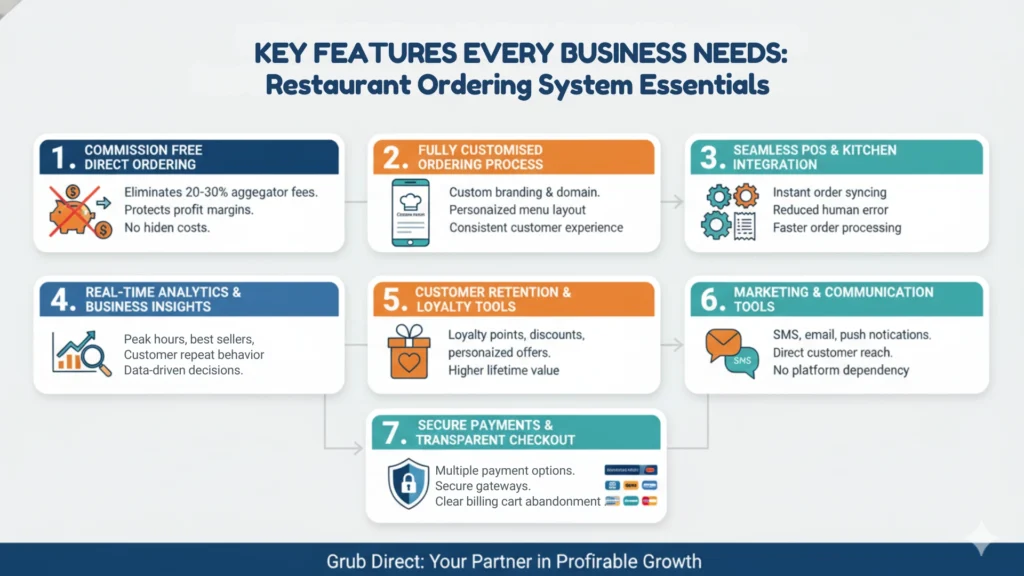
Key Features Every Business Needs
Understanding the right restaurant ordering system features is what separates profitable restaurants from those struggling with margins.
Here are the essential features that matter in 2026.
1. Commission Free Direct Ordering
One of the most critical expectations today is eliminating third-party commissions. Many restaurants still lose between 20% and 30% per order due to aggregator platforms.
In real world discussions from restaurant operators, the effective loss can even go higher once ads, delivery charges, and hidden deductions are included. This is why commission-free ordering is no longer optional.
This is also one of the best online ordering system features, as it directly protects profit margins and ensures long term sustainability.
2. Fully Customised Ordering Process
Consumers ought to feel as though they are placing their orders straight from the restaurant rather than a marketplace.
A strong system allows:
- Custom branding and domain
- Personalized menu layout
- Consistent customer experience
According to industry research, restaurant owned apps and websites now account for over 60% of digital orders, showing a clear preference for direct brand interaction.
This makes branding one of the most important food ordering software requirements today.
3. Seamless POS and Kitchen Integration
Manual order processing is a major operational pain point for restaurants. Orders must be manually entered in the absence of integration, which causes errors and delays.
A well built system ensures:
- Instant order syncing to kitchen
- Reduced human error
- Faster order processing
This is one of the most practical restaurant ordering system features because it directly improves day to day efficiency.
4. Real Time Analytics and Business Insights
Restaurants are not using intuition, they are using data.
A strong system provides insights like:
- Peak ordering hours
- Best selling items
- Customer repeat behavior
- Revenue trends
Restaurants using analytics driven systems have reported better decision making and improved customer retention strategies. These insights are now considered a standard part of the best online ordering system features.
5. Customer Retention and Loyalty Tools
Retaining existing customers is profitable, but acquiring new ones is expensive.
A strong system includes:
- Loyalty points
- Discount campaigns
- Personalized offers
Studies consistently show that repeat customers can contribute significantly higher lifetime value compared to one time buyers, making this a core part of food ordering software requirements.
6. Marketing and Communication Tools
Restaurants often rely too heavily on third-party platforms for visibility.
Modern systems now include:
- SMS campaigns
- Email marketing tools
- Push notifications
This allows restaurants to communicate directly with their customers instead of paying for visibility every time. These tools are now considered essential restaurant ordering system features, especially for growth focused businesses.
Grub Direct also integrates similar direct communication tools, enabling restaurants to run targeted campaigns without losing control of customer data.
7. Secure Payments and Transparent Checkout
Security plays a major role in online ordering trust.
A proper system should support:
- Multiple payment options
- Secure gateways
- Transparent billing
Without this, cart abandonment rates increase significantly, affecting revenue.
Real Life Case Study: Switching to Direct Ordering
A mid-sized restaurant chain in the UK recently transitioned from third party delivery apps to a direct ordering system built around full brand ownership and integrated operations.
Before the switch:
- Around 25% commission per order was being paid to aggregators
- Limited customer data visibility
- Heavy reliance on discount-driven orders
After implementing a direct system:
- Online orders increased by nearly 38% within a few months
- Monthly commission savings reached approximately £3,000–£4,500
- Repeat customer base grew significantly due to loyalty tools and direct engagement
The most important change wasn’t just revenue, it was control. The restaurant finally owned its customer data, pricing strategy, and communication channels.
This reflects a wider industry trend where restaurants are prioritising food ordering software that gives them independence rather than dependency.
Common Mistakes Restaurants Still Make
Even today, many restaurants choose systems without fully understanding what matters.
Common mistakes include:
- Choosing based only on price
- Ignoring integration capabilities
- Overlooking marketing tools
- Over dependence on third party apps
These can result in revenue loss over time and restricted growth.
Future of Restaurant Ordering Systems
The future is moving toward smarter, automated systems.
Key trends include:
- AI based ordering suggestions
- Predictive demand forecasting
- Voice enabled ordering
- Fully automated customer journeys
As the market continues to grow toward multi billion dollar valuations globally, these innovations will define the next generation of restaurant ordering system features.
Conclusion
The restaurant ordering system is no longer a computer system, it’s the heart of the business. The right restaurant ordering system features directly impact profit, productivity, and customer loyalty. Making the right decision today means a restaurant can stay competitive in the future.
Ready to take control of your orders and stop losing margins to third party commissions?
Switch to a smarter, direct ordering approach today and start building stronger profits and customer relationships.
Explore Grub Direct now and get started before your competitors do.
FAQS
1. What features should the restaurant ordering system have?
The critical features are commission-free ordering, POS integration, analytics, branding and loyalty.
2. Why is POS integration important?
This allows data to sync with the kitchen automatically, without being entered manually, leading to speedy and accurate orders.
3. What are essential food ordering software requirements?
These include tech solution scalability, security, data intelligence, mobile responsiveness and integration with restaurant technology systems.
4. How do online systems boost revenues?
They reduce commission costs, increase direct orders, and help restaurants build repeat customers.
5. Is direct ordering a win-win for restaurants?
Yes, because they retain control of their brand and customers, including all revenue generated.