How to Choose the Best Online Ordering System for Takeaway
You understand the pressure of operating a takeaway in the UK. Your margins are tight. Friday nights are chaotic and with the ringing of your telephone, customers walking in, and Just Eat having their tablet ring all at once, you are probably asking yourself if there is a more efficient way to handle orders.
There is. But choosing the right online ordering system for takeaway is not as simple as picking whoever shows up first on Google.
The wrong one can slowly and silently be costing you thousands a year in commission, you’re bound into an agreement and stuck as the contract means no flexibility, plus you know nothing of your own customers at all. The right one puts you in command of your own orders, margins, customers.
This guide is written specifically for UK takeaway owners. No generic advice. Basically a clear breakdown of what you want to know, what it actually costs, and the questions to be asking before signing any deals.
Why Most Takeaways Are Still Losing Money They Do Not Have To
Before discussing features and checklists, it’s good to frame the issue precisely.
Third party services like Just Eat, Deliveroo and Uber Eats contributed in putting millions of UK consumers on line. But staying on those platforms long-term comes at a cost.
Here is what the commission structure actually looks like in 2026:
Platform | Commission Rate | Additional Charges |
Just Eat (self-delivery) | 14% + VAT | £295 setup fee + 50p per online payment |
Just Eat (platform delivery) | Up to 32% | – |
Uber Eats (platform delivery) | 30% | ~£3.50 customer delivery fee |
Deliveroo | 20-30% | Setup fees, menu change fees |
Put that in real numbers. A takeaway doing £8,000 per month through Just Eat with platform delivery is handing over between £1,120 and £2,560 every single month before paying for ingredients, staff, or rent.
A direct online ordering system does not eliminate third-party platforms overnight but it builds a channel where every order keeps significantly more profit in your pocket. To understand what that shift looks like in practice, our guide on why your restaurant needs its own online ordering system walks through the numbers in detail.
What to Look for: The Honest Checklist
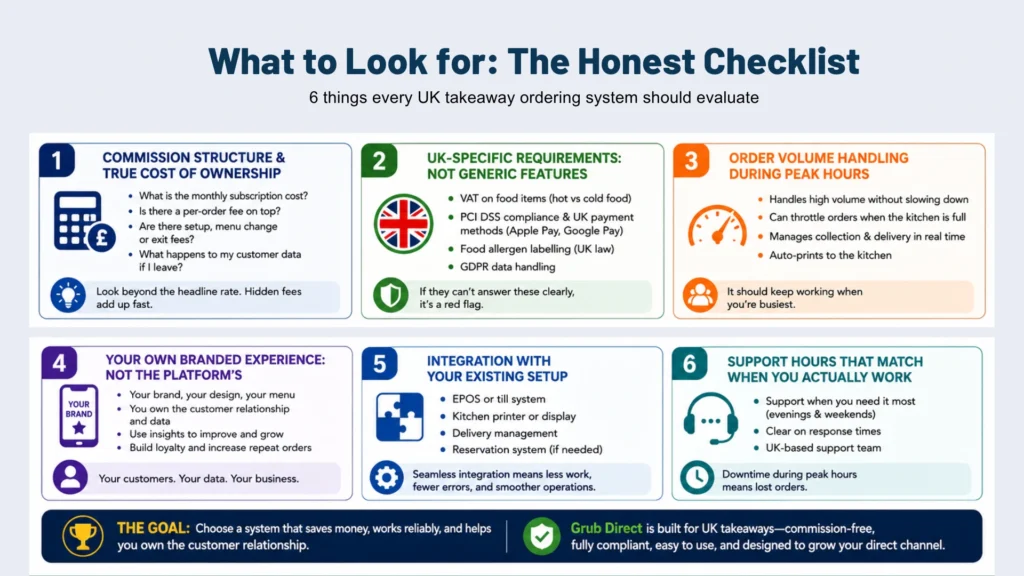
Not every takeaway needs the same system. A busy 80-cover restaurant has different needs to a two-person fish and chip shop. But there are six things every UK takeaway ordering system should evaluate before choosing any platform.
1. Commission Structure and True Cost of Ownership
This is the most important filter and the one most often glossed over in marketing materials.
Ask every provider these exact questions:
- What is the monthly subscription cost?
- Is there a per-order fee on top?
- Are there setup fees, menu change fees, or exit fees?
- What happens to my customer data if I leave?
Some platforms present a low commission headline number and bury additional charges in the small print. Just Eat’s 50p online payment fee, for example, adds up fast at volume 400 orders per month adds £200 on top of commission.
Grub Direct’s pricing model uses a flat monthly fee with no percentage cuts per order. For a takeaway doing consistent volume, this typically saves thousands per year compared to percentage-based models.
2. UK-Specific Requirements: Not Generic Features
A system built for the US or Australian market will not handle UK requirements properly. Before committing, confirm the system handles:
- VAT on food items correctly: UK VAT rules on hot vs cold food are specific and need to be calculated accurately on every receipt
- PCI DSS Compliance and Limitations for UK Payment Methods: contactless card restrictions, Apple Pay, Google Pay
- Food Allergen labelling: You should ensure that your ordering systems support allergen label requirements by UK Food Information Regulations.
- GDPR data handling: Any system storing customer data must comply with UK data protection law
If a provider cannot answer these questions clearly, that is a red flag before you even reach the features conversation.
3. Order Volume Handling During Peak Hours
The whole point of an online ordering system is that it keeps working when things get hectic. But not all systems are built for high volume.
Ask to see or speak to restaurants using the system on a Friday or Saturday evening. Specifically check:
- Will it be able to deal with orders placed simultaneously without affecting the speed of the process?
- Is there any throttling feature that will allow you to restrict the number of orders coming in once the kitchen is full?
- How does it handle the transition between collection and delivery orders in real time?
- Does it auto-print to the kitchen, or does someone still need to manually confirm?
A system that requires manual intervention during peak hours defeats the purpose of having one. Grub Direct’s takeaway EPOS system is designed around peak-hour performance with orders flowing automatically from the customer’s device straight to the kitchen printer or display screen with no manual step in between.
4. Your Own Branded Experience: Not the Platform’s
Your customers will be creating a relationship with Just Eat by ordering from their website; they accumulate the reward points, they own the data, and it is Just Eat that will determine which restaurant will be recommended next time to your customer.
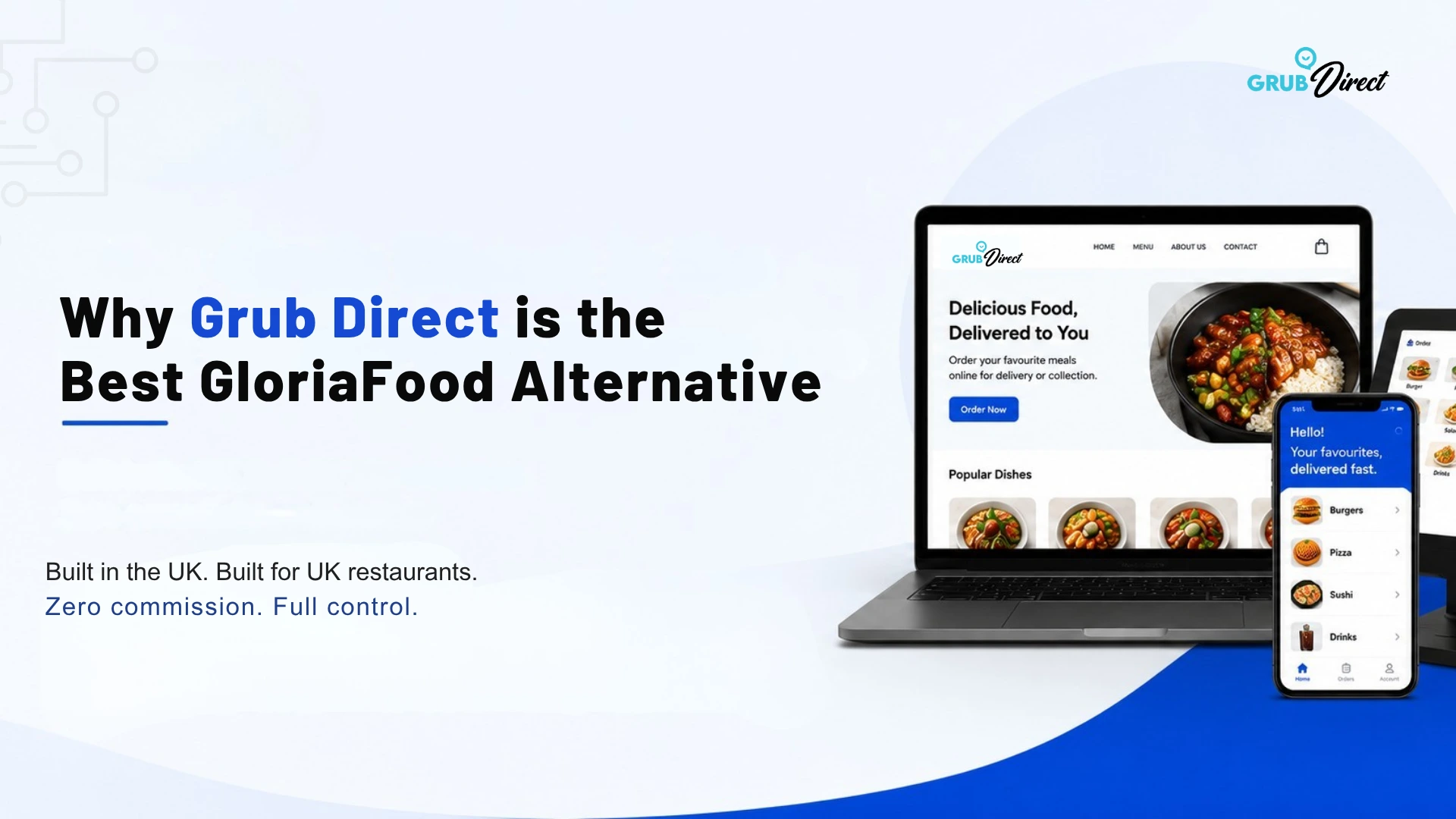
A direct ordering system gives you a branded website and app where customers order directly from your takeaway. Your name, your design, your menu and crucially, your customer data.
This matters because customer data is how you improve. Information about dishes that are commonly purchased on Tuesday, employees who have not placed an order for six weeks, and when is the peak hour of the restaurant can be used to make well-informed decisions. You will know the total orders placed through the third party app. With a direct system, you see customers.
5. Integration With Your Existing Setup
A new ordering system should make your operation smoother, not add a separate screen and process to manage.
Before signing up, confirm the system integrates with:
- Your existing EPOS or till system
- Your kitchen printer or display screen
- Your delivery management, if you handle your own drivers
- Your reservation system, if you take table bookings
Systems that sit as an island with orders arriving in one place and needing to be manually entered somewhere else create more work, not less, and introduce more room for errors.
6. Support Hours That Match When You Actually Work
Takeaways are most active during evening hours from 5pm until 10pm, including weekends. A technical issue during that window is not a minor inconvenience, it is lost orders and frustrated customers.
Check exactly what the support offering is. Some companies claim 24/7 customer service in their marketing, but they have only emails open during night hours. Check the exact hours and ask about response time commitment and whether support is UK based.
Direct Ordering vs Third-Party Platforms: Which Should You Use?
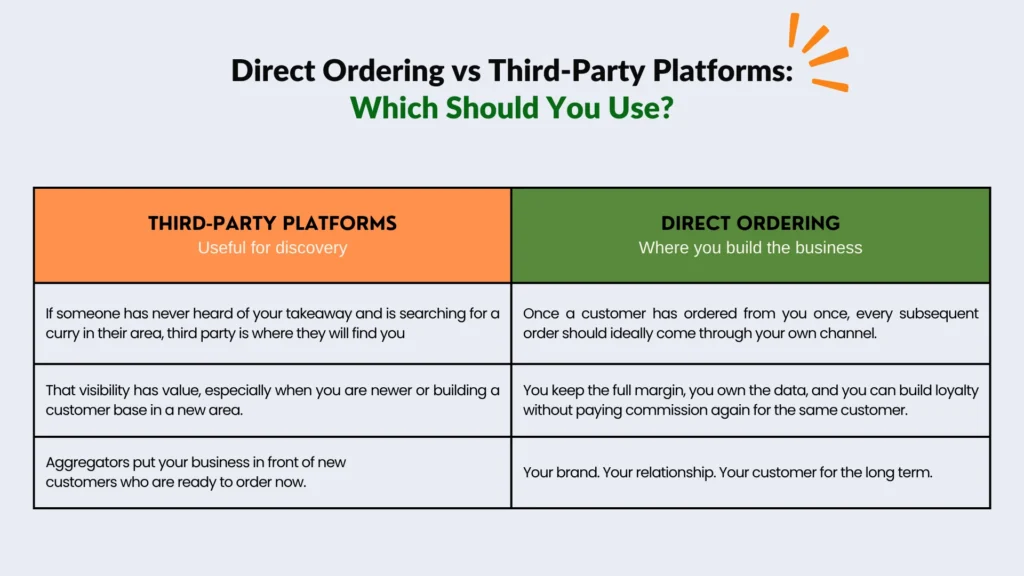
The honest answer is that most takeaways should use both but with a clear strategy about what each one is for.
Third-party platforms are useful for discovery. If someone has never heard of your takeaway and is searching for a curry in their area, Just Eat is where they will find you. That visibility has value, especially when you are newer or building a customer base in a new area.
Direct ordering is where you build the business. Once a customer has ordered from you once, every subsequent order should ideally come through your own channel where you keep the full margin, you own the data, and you can build loyalty without paying commission again for the same customer.
The goal is to gradually shift your order mix. A takeaway doing 80% of its volume through Just Eat and 20% direct is in a vulnerable position. One where it is 50/50 or better has resilience, better margins, and more control.
Grub Direct is built around this principle. For any takeaway ordering system to work long term, it needs to reduce commission dependency while keeping the customer experience simple. It gives UK restaurants and takeaways the tools to grow their direct channel commission-free ordering, a branded customer-facing experience, and integration with their existing operations while they continue using aggregators for discovery.
Questions to Ask Any Provider Before You Sign
Use this list as your standard due diligence before committing to any system:
On costs:
- What is the total monthly fee?
- Are there any per order charges on top of the subscription?
- Are there any setup, onboarding, or menu change fees?
- What are the termination terms and notice period?
On technical fit:
- Does it handle UK VAT correctly on food items?
- Is it GDPR compliant and who owns my customer data?
- Will it integrate with my current EPOS system?
- Can it handle peak-hour volume without slowing down?
On support:
- What are the actual support hours, not the marketing version?
On ownership:
- Do I own my customer list if I leave?
- Can I export my order history and customer data?
- Will my branded domain and app belong to me?
Any provider that cannot answer these questions clearly and quickly is worth being cautious about.
A Realistic Timeline: What to Expect When Setting Up
One concern many takeaway owners have is disruption during setup. A reasonable direct ordering system can be up and running in under two weeks. Here is a typical timeline:
Week 1: Menu setup, branding, payment integration, and testing
Week 2: Staff training, soft launch to existing customers, and checking order flow through to kitchen
Week 3 onwards: Start promoting the direct channel add the link to your packaging, social media, and Google Business Profile
You do not need to switch off your existing platforms while this happens. Most takeaway ordering systems run both in parallel during the transition period and gradually shift volume as direct orders build.
Why Grub Direct
Grub Direct is built specifically for UK restaurants and takeaways. It is not a generic platform adapted for the UK market. It was designed here, for businesses like yours.
The core offering is straightforward: a commission-free direct ordering system with a branded customer experience, integrated with your EPOS and kitchen, backed by a UK-based support team that works the hours you work.
There are no percentage cuts on orders. No third-party owning your customer relationships. And no complex setup that requires a technical team to manage.
In case you currently pay thousands of pounds in commissions each month and you would like to see how an order management system would work for your business, then what you should do first is to have a live demo of the system.
Conclusion
Choosing the best online ordering system for takeaway comes down to five practical things:
- True cost: not headline commission rates, but total cost per order including all fees
- UK compliance: VAT, allergens, GDPR, and UK payment standards
- Peak hour performance: a system that works when you are busiest
- Data ownership: your customers belong to you, not the platform
- Support hours: available when your takeaway is actually open
Third-party platforms have a role, but they should be one part of your strategy, not all of it. A direct ordering system is how you take back control of your margins and your customer relationships.
Ready to see what a direct ordering channel could look like for your takeaway? Book a demo with Grub Direct and get a live walkthrough built around your menu and setup.FAQS
Do I need to leave Just Eat or Uber Eats to use a direct ordering system?
No. Most takeaways run both in parallel. The goal is to gradually build up your direct order volume over time so you become less dependent on platforms taking a cut of every order.
How much can I realistically save by switching to direct ordering?
It depends on your current volume and the commission rate you are on. A takeaway doing £6,000 per month through a platform at 25% commission is paying £1,500 per month in fees. Even if direct ordering takes three to six months to reach that volume, the annual saving is significant.
Is it difficult for customers to use a direct ordering system?
A well-built system is as easy to use as any third-party app and in some cases easier, because there is no account needed on a separate platform. The key is making the link easy to find: on your packaging, your social pages, and your Google Business Profile.
What happens to my customer data if I stop using Grub Direct?
Your customer data belongs to you. You can export your full customer and order history at any time.
How long does setup take?
Most takeaways are live within one to two weeks, depending on menu complexity and how quickly the onboarding steps are completed.