
How to Increase Online Orders for Your Restaurant in 2026
Running restaurants is not easy. The owners of restaurants have to struggle between order management and employee staffing, monitoring inventory and ensuring payment flows, and so on. The manual processes or various disconnected tools, which many people are still using, may create errors, inefficiency, and loss of revenue. That is where the all in one restaurant management software comes into play. Integrating the most important operational tools in one platform enables the restaurants to improve their workflow, minimise errors, and enhance the customer experience.
Common Challenges Restaurants Face Daily
1. Managing Orders from Multiple Channels
Today, restaurants have orders of various origins, such as dine in, takeout, delivery applications, phone calls, and online orders via websites. It is very confusing to handle all these orders manually, and therefore might lead to missed or delayed orders.
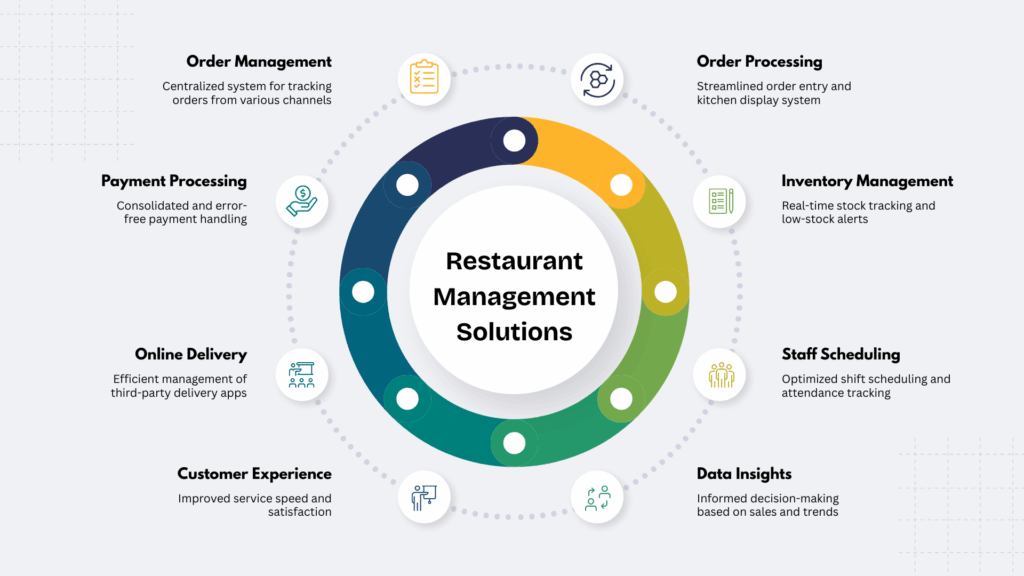
A single dashboard of an all in one software for restaurant management helps the staff to track the incoming orders in real-time as they are centralised in a single dashboard. Indicatively, an online ordering system allows online ordering and delivery of orders to the POS system so that no order is lost across the channels.
2. Speeding Up Order Processing
Entry of orders by hand delays service and creates the possibility of errors between servers and the kitchen.
Orders are placed straight off the POS to the kitchen display system (KDS) with an all-in-one restaurant management software. This eliminates human error, accelerates service, and promotes accuracy, thereby making the dining experience easier to the consumers.
3. Efficient Inventory Management
Running out of important ingredients during service is the nightmare of all restaurant owners. Inventory management is tedious to track manually and can be inaccurate.
The new restaurant operations software also tracks the stock level in real time, notifies the managers when stock is low, and minimises wastage of food. Using one system, restaurant owners can easily make purchase decisions and have regular stock levels.
4. Staff Scheduling and Payroll
Another issue facing restaurants is the coordination of shifts, attendance, and calculating payroll.
An effective modern all in one restaurant management software package has workforce management tools. The restaurant owner can schedule the shifts of staff and track the hours worked by the staff. This will ensure that the staffing requirements are optimised to the highest without overworking the employees during the peak season.
5. Data-Driven Business Insights
The owner makes operational decisions that rely on unreliable data that can affect profitability and efficiency.
An all in one system offers more specific reports regarding the sales, busiest hours, most ordered foods, and the trends of revenues. The restaurant management system can enable the restaurant owners to make decisions that are informed by data to increase sales and enhance operations.
6. Improving Customer Experience
Errors in the orders, queues, or slow payments may cause bad experiences to the customers.
Having an all in one restaurant management software, the restaurants will guarantee accuracy of orders, quicker delivery, and simplified payment. Integrated systems have been identified to improve the service speed and customer satisfaction in many restaurants utilising restaurant operations software.
7. Managing Online Orders and Delivery
Third-party delivery apps have become increasingly significant, but handling several platforms could be overwhelming.
An all in one software for restaurant management will incorporate online ordering and delivery management as part of the restaurant system. By enhancing order tracking, customers receive prompt information on delivery. Time can be saved, and the efficiency of system operation is increased with these capabilities of the restaurant management platform.
8. Simplifying Payment Processing
Types of payment that restaurants may receive are usually cash, card, and digital wallet. Manual processing can reduce the speed of service as well as error levels.
Under all in one restaurant management software, the payment processing is consolidated. This improves the error of order tracking and informs customers about the status of their delivery in real-time.
Why Restaurants Are Choosing All in One Software
- Saves Time: The daily operations, as well as order management to payroll, are streamlined, which saves manpower.
- Minimizes Operational errors: Centralised control makes fewer mistakes in orders, inventory, and staff scheduling.
- Enhances customer satisfaction: Immediate customer care and simple payment will be the major source of customer satisfaction, in addition to other ones.
- Equips with able insight: Offers reports and analytics in order to make valid decisions.
- Unites big features: Merges POS and online ordering, delivery management, inventory, and reporting in one single system.
Conclusion
A restaurant is a place of continuous problems, where orders and employees must be handled, stock and money must be tracked, and payroll must be made. With an all in one restaurant management software, restaurants can be able to streamline these problems, make it more productive, and make the process more enjoyable among the employees and consumers.
Investing in one system, be it a restaurant management system or restaurant operations software, helps the restaurants to be in order, responsive and competitive. An integrated approach is becoming a must, not a luxury, for restaurant owners who want to optimise their operations in order to increase profitability.
FAQS
What is all inclusive restaurant management software?
It is a computer program used to combine order management, staff shift, inventory control, payment, and reporting within one system.
Is such all in one software beneficial to small restaurants?
Yes. With an all in one system, even small restaurants would have the ability to save time, reduce errors, and enhance efficiency.
Does it connect with delivery platforms?
Several applications, such as Grub Direct, are connected to third-party delivery applications to manage online orders easily.
What does it do to enhance customer experience?
Consolidation of orders, accuracy, faster service, and simplification of payments.
Is it able to assist in financial reporting?
Yes. The integrated systems will offer detailed sales and revenue reporting, as a result, it will be easier to monitor performance.